
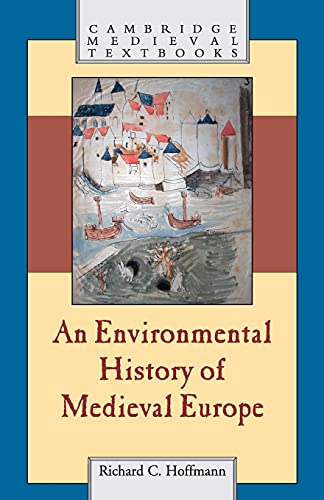
An environmental history of medieval Europe / by Richard C. Hoffmann.
Material type: TextSeries: Cambridge medieval textbooksCambridge ; New York : Cambridge University Press, 2014Description: xvii, 409 pages : illustrations ; 23 cmContent type:
 - text
- unmediated
- volume
- 9780521700375 (paperback)
- Human ecology -- Europe -- History -- To 1500
- Nature -- Effect of human beings on -- Europe -- History -- To 1500
- Social ecology -- Europe -- History -- To 1500
- HISTORY / Europe / General
- Europe -- Environmental conditions -- History -- To 1500
- Europe -- Social conditions -- To 1492
- Civilization, Medieval
- 304.2094 HOF [ Shelf 18 ]
| Cover image | Item type | Current library | Home library | Collection | Shelving location | Call number | Materials specified | Vol info | URL | Copy number | Status | Notes | Date due | Barcode | Item holds | Item hold queue priority | Course reserves | |
|---|---|---|---|---|---|---|---|---|---|---|---|---|---|---|---|---|---|---|
 Book
Book
|
Indian Institute Of Management, Shillong | 304.2094 HOF [ Shelf 18 ] (Browse shelf(Opens below)) | 2 | Available | 0011802 | |||||||||||||
 Reference
|
Indian Institute Of Management, Shillong | 304.2094 HOF [ Shelf 18 ] (Browse shelf(Opens below)) | 0 | Not for loan | 0011520 | |||||||||||||
|
Book
|
Indian Institute Of Management, Shillong | 304.2094 HOF [ Shelf 18 ] (Browse shelf(Opens below)) | 1 | Available | 0011521 |
Includes bibliographical references.
Introduction: Thinking about medieval Europeans in their natural world -- Long no wilderness -- Intersecting instabilities : culture and nature at medieval beginnings (ca.400-900) -- Humankind and God's creation in medieval minds -- Medieval land use and the formation of traditional European landscapes -- Medieval use, management, and sustainability of local ecosystems 1 : primary biological production sectors -- Medieval use, management, and sustainability of local ecosystems 2 : interactions with the non-living environment -- "This belongs to me..." -- Suffering the uncomprehended : disease as a natural agent -- An inconstant planet, seen and unseen, under foot and overhead -- A slow end of medieval environmental relations -- Afterword.
"How did medieval Europeans use and change their environments, think about the natural world, and try to handle the natural forces affecting their lives? This groundbreaking environmental history examines medieval relationships with the natural world from the perspective of social ecology, viewing human society as a hybrid of the cultural and the natural. Richard Hoffmann's interdisciplinary approach sheds important light on such central topics in medieval history as the decline of Rome, religious doctrine, urbanization and technology, as well as key environmental themes, among them energy use, sustainability, disease and climate change. Revealing the role of natural forces in events previously seen as purely human, the book explores issues including the treatment of animals, the 'tragedy of the commons,' agricultural clearances and agrarian economies. By introducing medieval history in the context of social ecology, it brings the natural world into historiography as an agent and object of history itself"-- Provided by publisher.
There are no comments on this title.